Look beyond the name on the product page
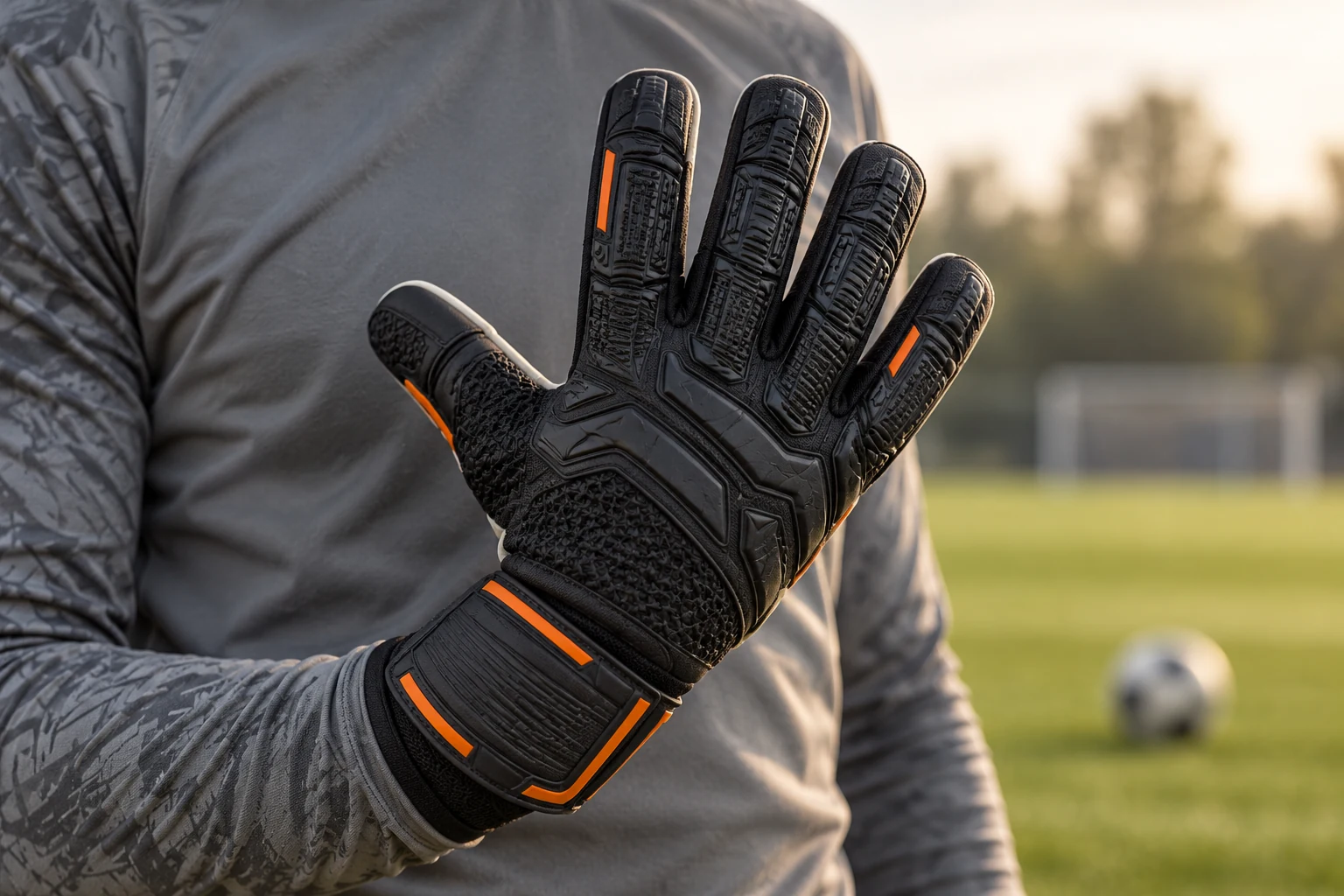
Manufacturers use different names for their constructions, particularly when several approaches are combined. Ask what the name means on the specific model you are considering. Clear photographs of the palm, fingers, thumb and cuff can help explain the answer.
uhlsport's own guidance notes that keepers differ in their preference for close-fitting internal-seam and wider external-seam designs. That supports a practical principle: there is no single cut label that settles every player's fit preference. Review the product on the intended wearer.
Use construction language to ask better questions
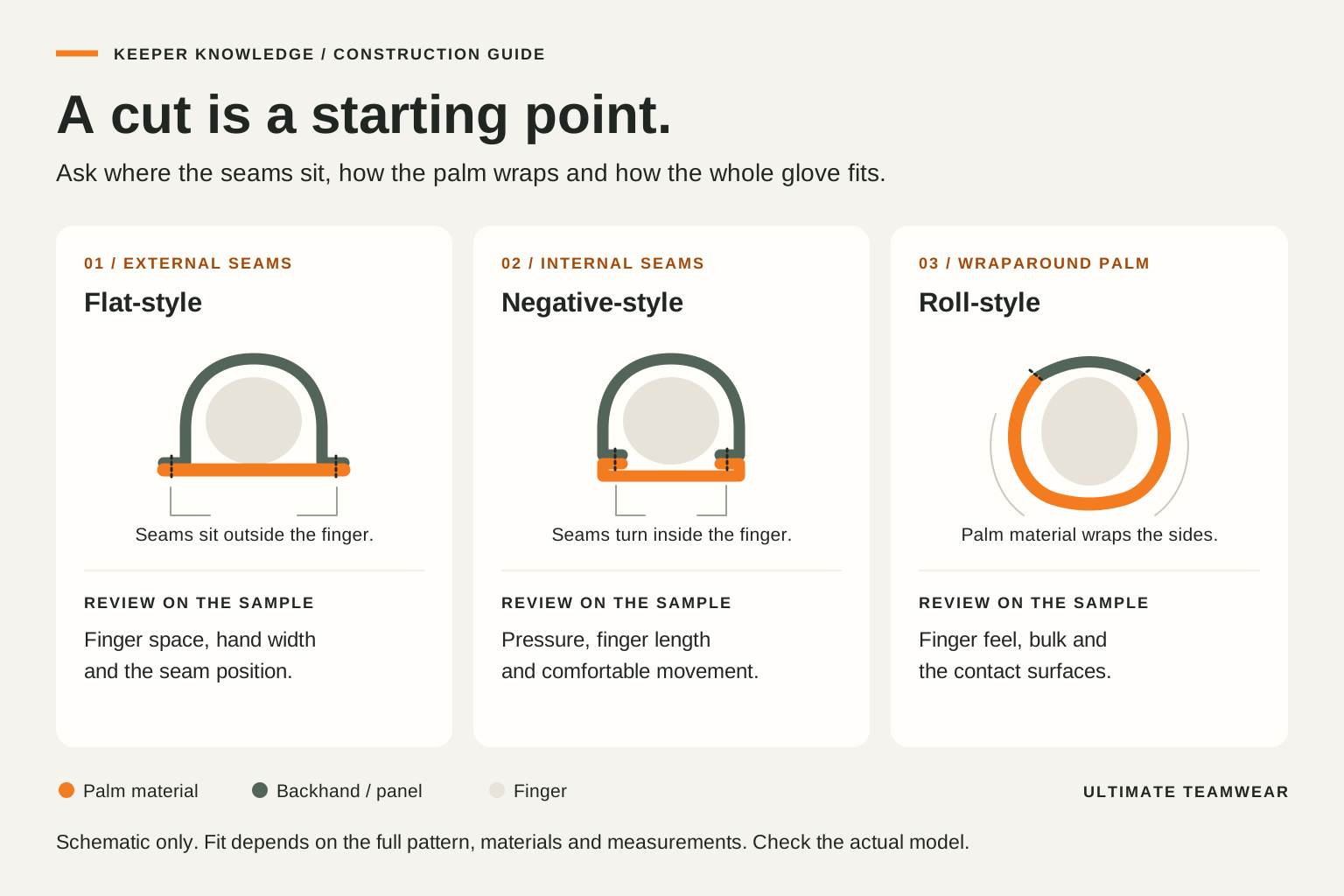
The following table is a simplified discussion aid, not a universal specification for every model. A hybrid design needs its own explanation because different fingers or areas may use different constructions.
| Approach | What to ask about | What to review on a sample |
|---|---|---|
| External-seam / flat-style | Where are the seams and how much room is intended? | Finger space, hand width and seam position |
| Internal-seam / negative-style | Which seams are internal and how close is the intended fit? | Pressure, finger length and movement |
| Wraparound / roll-style | Where does the palm material wrap around the fingers? | Finger feel, bulk and contact surfaces |
| Hybrid | Which construction is used in each area? | Whether the combined design feels consistent |
Treat sizing as model-specific information
Use the measurement method supplied for the model. Reusch, for example, instructs customers to measure the circumference around the widest part of the hand, excluding the thumb, and compare it with its own chart. That chart belongs to Reusch; it should not be relabelled as another manufacturer's sizing.
For a custom range, agree the measurements and size coverage with the manufacturer. Ask how the sample size relates to the proposed size range. A familiar size number from another product can be helpful context, but it does not replace a fit review.
Check the whole glove, not only the fingers
Describe the fit at the fingertips, across the hand and around the wrist. Check entry into the glove, closure adjustment and whether the keeper can move comfortably. A finger construction that feels suitable can still sit within a glove whose cuff does not suit that wearer.
Record comments in specific terms. “More room across the hand” is more useful than “a bigger glove” if the finger length already works. Discuss which measurements or construction choices could address the observation before changing several details at once.
For brands: explain the fit honestly
Your product page should describe the intended feel and show the construction clearly. Avoid presenting a cut as a guarantee of catching ability or claiming that one design suits every keeper. Give customers a measurement method and a route for asking questions.
Use sample feedback to improve the description, and review repeat fit questions after launch. Those questions can reveal where your size guidance or product photography needs to be clearer, even when the physical product is unchanged.
Put it into practice
Your next steps
- Ask what the cut name means on the specific model.
- Use the selected manufacturer's measurement method.
- Review the fingers, hand and wrist together.
- Describe fit clearly without promising universal performance.
Developing a glove range? Discuss your preferred construction and fit direction with Ultimate Teamwear.
Discuss your project